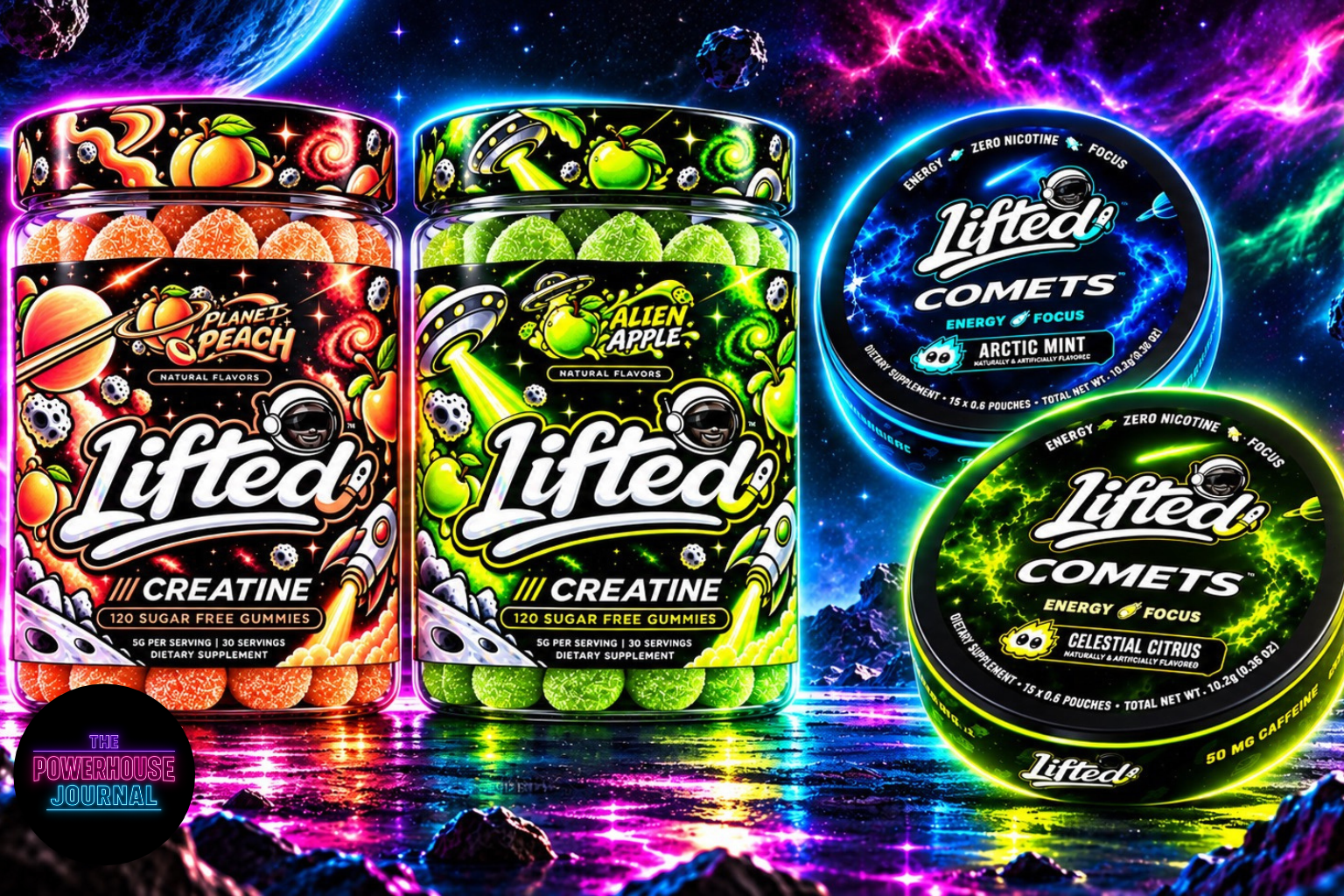
From the makers of MuscleSport comes a different approach to energy: one product designed for an immediate boost in alertness and focus, and another targeting the cellular energy system that powers muscular performance.
The energy category is evolving, and apparently, the team behind MuscleSport has no intention of sitting on the sidelines.
Enter Lifted, the brand from the makers of MuscleSport, which is taking a broader approach to what energy actually means.
Its latest offerings, Lifted Comets Energy + Focus Pouches and Lifted Creatine Gummies, target two very different aspects of performance: neurological stimulation and cellular energy production.
And that's an important distinction.
When most consumers hear the word energy, they immediately think of caffeine. Energy drinks, pre-workouts, coffee, and increasingly, functional pouches have conditioned us to associate energy with feeling stimulated.
But stimulation and energy production are not interchangeable.
Caffeine primarily works by blocking adenosine receptors in the central nervous system, reducing the perception of fatigue and increasing alertness.
Creatine, on the other hand, supports the phosphocreatine system, which helps rapidly regenerate adenosine triphosphate (ATP), the molecule cells use to power biological processes, including muscular contractions.
One helps you feel more awake. The other supports your body's ability to regenerate energy during high-intensity activity.
That's the opportunity Lifted appears to be pursuing: expanding beyond the traditional definition of an energy product without abandoning the science that makes these ingredients relevant.
But as always, the Powerhouse Standard doesn't care how cool the packaging looks if the formula can't back it up.
So let's get into the actual ingredients, the doses, the delivery systems, and whether these products deserve a place in an increasingly crowded market.
Lifted Comets: Energy and Focus Without the Drink
Lifted Comets enters the growing category of nicotine-free functional pouches, delivering caffeine and cognitive-support ingredients through a small oral pouch rather than a beverage or capsule.
The concept is straightforward: a portable, discreet alternative for consumers who want a modest dose of caffeine without opening another energy drink.
Each tin contains 15 pouches, with two flavors shown in the launch materials: Arctic Mint and Celestial Citrus.
The Formula: What's Actually Inside?
Each pouch delivers:
Vitamin B12 (methylcobalamin): 1,000 mcg
GeniusPure® Alpha-GPC (90%): 150 mg
Caffeine anhydrous: 50 mg
Toothed clubmoss extract (1% huperzine A): 2.5 mg
The formula is fully disclosed, and that's already a positive. Consumers know how much of each active ingredient they're getting.
However, disclosed dosing is only the beginning. The next question is whether those amounts are meaningful.
Caffeine Anhydrous — 50 mg
Caffeine is the primary acute stimulant in Comets, and at 50 mg per pouch, Lifted has deliberately positioned this below the caffeine content of most mainstream energy drinks.
For perspective, 50 mg is approximately one-quarter of the caffeine in a typical 200 mg energy drink.
That makes Comets potentially appealing to consumers looking for smaller, more controllable caffeine servings.
Caffeine acts primarily as an adenosine receptor antagonist, reducing perceived fatigue and improving alertness. Research also supports its ability to improve certain aspects of exercise performance, particularly at higher doses relative to body weight.
However, the important distinction here is that 50 mg should be evaluated as a moderate alertness dose, not automatically as an ergogenic dose equivalent to those used in sports-performance trials.
The pouch format also introduces an interesting pharmacokinetic question.
Because the product is held in the mouth, some caffeine may be absorbed through the oral mucosa, while some may be swallowed and absorbed through the gastrointestinal tract.
That doesn't automatically establish faster onset or greater bioavailability than an energy drink.
A sensible caffeine amount for consumers who don't want another 200–300 mg hit. But claims of faster absorption would need product-specific evidence.
GeniusPure® Alpha-GPC — 150 mg at 90%
Alpha-GPC, or alpha-glycerylphosphorylcholine, is a choline-containing compound that can contribute to the body's choline pool.
Choline is necessary for the synthesis of acetylcholine, a neurotransmitter involved in attention, learning, memory, and neuromuscular signaling.
Lifted uses branded GeniusPure® Alpha-GPC at 90% purity from NNB Nutrition
At 150 mg of the branded material, the formula supplies approximately 135 mg of Alpha-GPC, assuming the declared amount refers to the 90% raw material.
That distinction matters when comparing the formula with published studies.
Human research investigating Alpha-GPC has frequently used larger quantities, including doses around 300–600 mg or higher, depending on the outcome being measured.
While the ingredient has a plausible cognitive rationale, the evidence for acute cognitive or physical performance benefits is mixed and not sufficient to assume that this particular dose will produce measurable improvements.
The use of a branded ingredient may offer advantages in sourcing and quality documentation, but the brand name itself doesn't establish efficacy.
Vitamin B12 — 1,000 mcg
This is where the label gets particularly interesting.
Each Comets pouch delivers 1 mg of vitamin B12 as methylcobalamin, representing approximately 41,667% of the Daily Value.
Yes, more than forty-one thousand percent.
B12 is essential for neurological function, red blood cell formation, and normal energy metabolism.
But here's the part consumers need to understand:
B12 is not a stimulant, and megadosing it doesn't automatically create more energy.
For individuals with a deficiency, correcting inadequate B12 status can meaningfully improve fatigue and other symptoms.
For individuals who already have adequate B12 status, however, there is little evidence that taking dramatically more than the daily requirement produces an immediate energy boost.
Methylcobalamin is a biologically active form of B12, but that doesn't mean a 1,000 mcg serving will outperform a lower appropriate dose in someone who isn't deficient.
Toothed Clubmoss Extract — 2.5 mg Standardized to 1% Huperzine A
Now we're getting into the more pharmacologically interesting part of the formula.
Lifted includes 2.5 mg of Huperzia serrata extract standardized to 1% huperzine A.
That works out to approximately 25 mcg of huperzine A per pouch.
Huperzine A is an acetylcholinesterase inhibitor, meaning it inhibits the enzyme responsible for breaking down acetylcholine.
By slowing acetylcholine breakdown, it can increase cholinergic signaling.
This creates a mechanistic rationale for combining huperzine A with a choline source such as Alpha-GPC.
However, mechanistic plausibility is not the same thing as demonstrating that a finished formula improves focus in healthy adults.
Huperzine A is also different from many conventional supplement ingredients because it has meaningful pharmacological activity and a relatively long duration of action.
That raises questions about repeated dosing, especially in a product consumers might treat like a nicotine-free pouch and use several times throughout the day.
At three pouches, for example, consumers would ingest approximately 75 mcg of huperzine A, alongside 150 mg of caffeine and 3,000 mcg of B12.
Lifted Creatine Gummies: A Different Kind of Energy
If Comets represents Lifted's approach to perceived energy and alertness, its creatine gummies represent something more foundational: supporting the body's actual energy-regeneration machinery.
And this is where Lifted's broader energy positioning gets interesting.
Creatine is frequently marketed as a muscle-building supplement. While that association isn't wrong, it doesn't fully explain why creatine works.
Creatine's most established performance benefit comes from its role in rapid ATP regeneration, particularly during repeated bouts of high-intensity muscular activity.
This isn't a trendy mechanism or a speculative ingredient story. Creatine monohydrate is one of the most extensively researched sports nutrition ingredients available.
The Formula: Five Grams of Creatine
Each four-gummy serving provides:
Creatine monohydrate: 5,000 mg
Calories: 30
Total carbohydrates: 8 g
Sugar alcohols: 8 g
Sodium: 60 mg
Each jar contains 120 gummies, providing 30 full servings.
The initial flavors shown are Alien Apple and Planet Peach, both presented as sugar-free gummies.
Most importantly, consumers receive a clearly disclosed 5 g serving of creatine monohydrate.
That's a meaningful distinction in a category where some products provide small amounts of creatine while relying heavily on convenience, flavor, and packaging to justify their positioning.
Five grams of creatine monohydrate falls directly within the commonly studied maintenance-dose range of 3–5 g per day.
It also means Lifted isn't attempting to reinvent creatine chemistry.
And that's a good thing.
Why Creatine Belongs in the Energy Conversation
To understand why creatine makes sense under an energy-focused brand, we need to talk about ATP.
ATP, or adenosine triphosphate, is the immediate energy currency used by cells.
Every muscular contraction requires ATP, whether you're lifting a barbell, sprinting, jumping, or simply moving throughout the day.
However, the body stores only a limited amount of readily available ATP.
During intense exercise, ATP must be regenerated continuously to sustain muscular contractions.
That's where phosphocreatine enters the picture.
Inside muscle cells, creatine can be converted into phosphocreatine, which serves as a rapidly accessible phosphate reserve.
When ATP is broken down into ADP during muscular activity, phosphocreatine can donate a phosphate group to regenerate ATP through the creatine kinase reaction.
In simplified terms:
Phosphocreatine + ADP → Creatine + ATP
By increasing muscle creatine stores through consistent supplementation, individuals can increase their phosphocreatine availability, helping support rapid ATP regeneration during demanding efforts.
This is particularly relevant for activities involving repeated high-intensity contractions, including sprinting, resistance training, and many forms of mixed-modal exercise.
Importantly, creatine does not function like caffeine.
You don't take five grams and suddenly experience an immediate wave of stimulation.
Its performance benefits generally develop as muscle creatine stores increase over days or weeks of supplementation.
And it doesn't replace carbohydrates, adequate calorie intake, or aerobic energy production.
The Powerhouse Take: Creatine absolutely has a legitimate place in the energy conversation, but specifically as a cellular energy-buffering and performance-support ingredient, not an acute stimulant.
That's a more scientifically defensible distinction than pretending every supplement that mentions ATP will make consumers feel energized.
Why Creatine Monohydrate Is the Right Choice
One of the strongest decisions in this formula is also one of the simplest: Lifted uses creatine monohydrate.
Not a proprietary creatine complex.
Not an exotic form with a dramatic absorption claim.
Not a novel ingredient that requires consumers to accept marketing promises in place of established evidence.
Just creatine monohydrate.
Decades of research support its ability to increase muscle creatine stores and improve high-intensity exercise capacity.
Alternative creatine forms have not consistently demonstrated superior outcomes over monohydrate.
But there is one important technical detail worth addressing.
The label declares 5,000 mg of creatine monohydrate, not 5,000 mg of creatine excluding the water molecule.
Creatine monohydrate is approximately 88% creatine by weight, meaning the serving supplies roughly 4.4 g of creatine itself.
That's completely normal, and it aligns with how standard creatine monohydrate doses are reported in research.
The serving is appropriately dosed.
The Real Challenge: Creatine Stability in Gummies
Here's where the Powerhouse Standard demands a little more than a good Supplement Facts panel.
Creatine monohydrate is extremely well studied in powder form, but incorporating it into a finished gummy introduces formulation challenges.
Creatine can undergo conversion to creatinine in aqueous environments, with degradation influenced by conditions including pH, temperature, moisture, and storage duration.
This doesn't mean creatine gummies inherently don't work.
It means manufacturers need to demonstrate that the labeled amount of creatine remains present throughout the product's shelf life.
That's particularly relevant for an acidic, flavored gummy matrix.
A five-gram label claim is excellent, but what matters is whether consumers are still getting that amount when they open the jar months after manufacturing.
The questions we'd want Lifted to answer are straightforward:
Is the creatine content verified through independent finished-product testing?
Has the product undergone real-time or accelerated stability testing?
Is creatinine formation monitored during shelf life?
Does the full 5 g of creatine monohydrate remain within specification through expiration?
Are the products tested for identity, potency, and relevant contaminants?
These aren't accusations about Lifted's formulation. They're the appropriate questions for any company entering the creatine gummy category.
The Powerhouse Take: The formula checks the dosing box. Finished-product stability and testing documentation would determine whether it clears the next level of scrutiny.
Sugar-Free Doesn't Mean Carbohydrate-Free
Now for a distinction that tends to get lost in supplement marketing.
Lifted's creatine gummies are advertised as sugar-free.
That's supported by their use of sugar alcohols rather than conventional sugar as the primary sweetening system.
But each four-gummy serving still contains 30 calories, 8 g of total carbohydrates, and 8 g of sugar alcohols.
The Alien Apple ingredient list includes maltitol syrup, isomalt, erythritol, pectin, malic acid, sodium citrate, citric acid, calcium lactate, natural apple flavor, spinach powder for coloring, and stevia leaf extract.
Maltitol syrup appears first on the ingredient list, followed by isomalt and erythritol.
These ingredients allow manufacturers to create a sweet, chewy product without relying on conventional sugar.
However, sugar alcohols aren't necessarily metabolically inert, and they aren't universally well tolerated.
Maltitol can contribute calories and may affect blood glucose, while several sugar alcohols can cause bloating, gas, or diarrhea, particularly when consumed in larger amounts.
Individual tolerance varies considerably.
For someone taking four gummies daily, this may be completely manageable.
For someone with a sensitive gastrointestinal system, however, eight grams of sugar alcohols in a single serving is worth considering.
And here's the distinction we want consumers to understand:
Sugar-free is a description of sugar content. It isn't a guarantee of zero calories, zero carbohydrates, or zero gastrointestinal consequences.
The use of pectin also means these gummies do not require animal-derived gelatin for their structure, although the ingredient list alone doesn't establish vegan certification.
Convenience Versus Cost
The biggest selling point of creatine gummies isn't necessarily improved performance compared with powder.
It's convenience.
Creatine monohydrate powder is inexpensive, extensively studied, easy to dose, and already highly effective.
Gummies offer an alternative for consumers who dislike powders, travel frequently, or simply prefer taking their supplements in a more enjoyable format.
That convenience can matter because consistent supplementation is what drives increases in muscle creatine stores.
But convenience also comes at a price.
Without a verified current retail price for these gummies, we can't calculate their cost per effective serving or compare them fairly against conventional creatine powder.
That's an important missing piece in the consumer-value assessment.
The Powerhouse Take: If the finished gummies reliably deliver the labeled creatine dose, the product offers a legitimate convenience benefit. But consumers shouldn't be led to believe gummies are inherently more effective than monohydrate powder.
Two Products, Two Energy Systems, One Bigger Brand Strategy
What makes these releases particularly interesting isn't simply that Lifted has entered two growing supplement categories.
It's how they fit into the brand's larger identity.
Lifted already has a foundation in pre-workout supplements, including its original formula and Hyperdrive Edition. The existing lineup emphasizes stimulant-driven energy, focus, pumps, and exercise performance.
Comets and Creatine Gummies extend that positioning into different consumption occasions.
Lifted Comets targets acute alertness and focus, appealing to adults seeking a smaller, portable caffeine serving.
Lifted Creatine Gummies target cellular energy regeneration, appealing to active adults prioritizing strength, power, and repeated high-intensity efforts.
And the existing pre-workout lineup serves consumers seeking a more comprehensive training formula.
This creates a broader definition of energy than simply increasing caffeine content.
Comets addresses the consumer who wants to feel more alert without drinking another beverage.
Creatine Gummies address the consumer who wants to support muscular performance through a well-established physiological pathway.
The strategy is coherent.
But the science behind these products isn't equally strong.
Creatine monohydrate has decades of human research supporting its efficacy for relevant exercise outcomes.
Comets combines an established stimulant with cognitive-support ingredients whose contribution at the labeled doses is less certain.
Those differences matter.
A strong brand strategy should connect products through a clear identity without overstating what each formula can accomplish.
The Powerhouse Verdict: Energy Is Bigger Than Caffeine
There's a reason the functional energy category is attracting so much attention.
Consumers are increasingly looking for products that fit their lifestyles rather than forcing their lifestyles to accommodate another drink, powder, or supplement routine.
And Lifted clearly understands that opportunity.
The Comets pouches offer a practical alternative to conventional caffeinated beverages, with a modest caffeine dose and a more complex cognitive-support formula.
The Creatine Gummies deliver a familiar, well-researched ingredient in a convenient format, while giving Lifted a legitimate connection to the cellular mechanisms underlying muscular energy production.
Of the two, the Creatine Gummies have the stronger evidence-backed performance proposition because the ingredient, dose, and intended physiological outcome are well established.
Comets has an interesting formulation, but its real-world cognitive benefits and repeated-use profile deserve additional scrutiny.
And both products still have questions to answer regarding finished-product testing and consumer value.
Here's the bigger takeaway.
Energy isn't just about how stimulated you feel. It's also about what your body can actually do.
Caffeine can help reduce perceived fatigue by stimulating the nervous system. Creatine can help regenerate ATP during demanding muscular activity.
Neither is a substitute for adequate nutrition, recovery, or sleep, and neither needs to be marketed as something it isn't.
Lifted has an opportunity to build a genuinely differentiated identity around these distinctions.
The brand already has the visual identity, the product variety, and a compelling positioning strategy.
Now the standard is simple: deliver the doses, validate the finished products, and let the science do the heavy lifting.
Because at The Powerhouse Journal, we don't judge a supplement by how exciting the label looks.
We judge it by what's inside, whether the evidence supports it, and whether consumers are actually getting what they pay for. No bullshit here.